Salesforce
Latest versionSalesforce is a leading CRM platform integrating sales, service, marketing, and analytics to build customer relationships and drive business growth
Authentication DetailsComposio-managed OAuth available
Frequently Asked Questions
How do I set up custom OAuth credentials for Salesforce?
Use your own Salesforce app when you want your app name on the consent screen, your own scopes, or control over the org's app policies. New orgs use External Client Apps; older orgs can still use Connected Apps.
Create the Salesforce app
If you don't have an org to test in, sign up for a free Salesforce Developer Edition.
Option A: External Client App
-
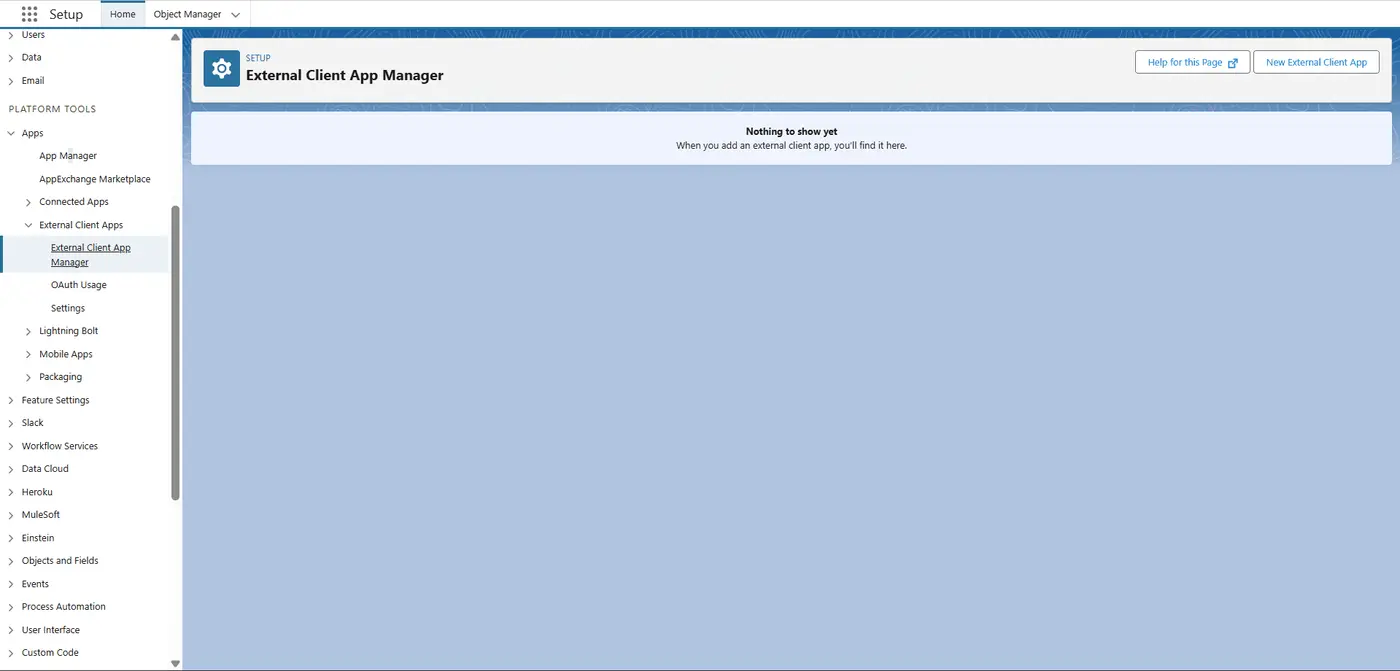
In Salesforce, click the gear icon → Setup. Search App Manager in Quick Find and open it.
-
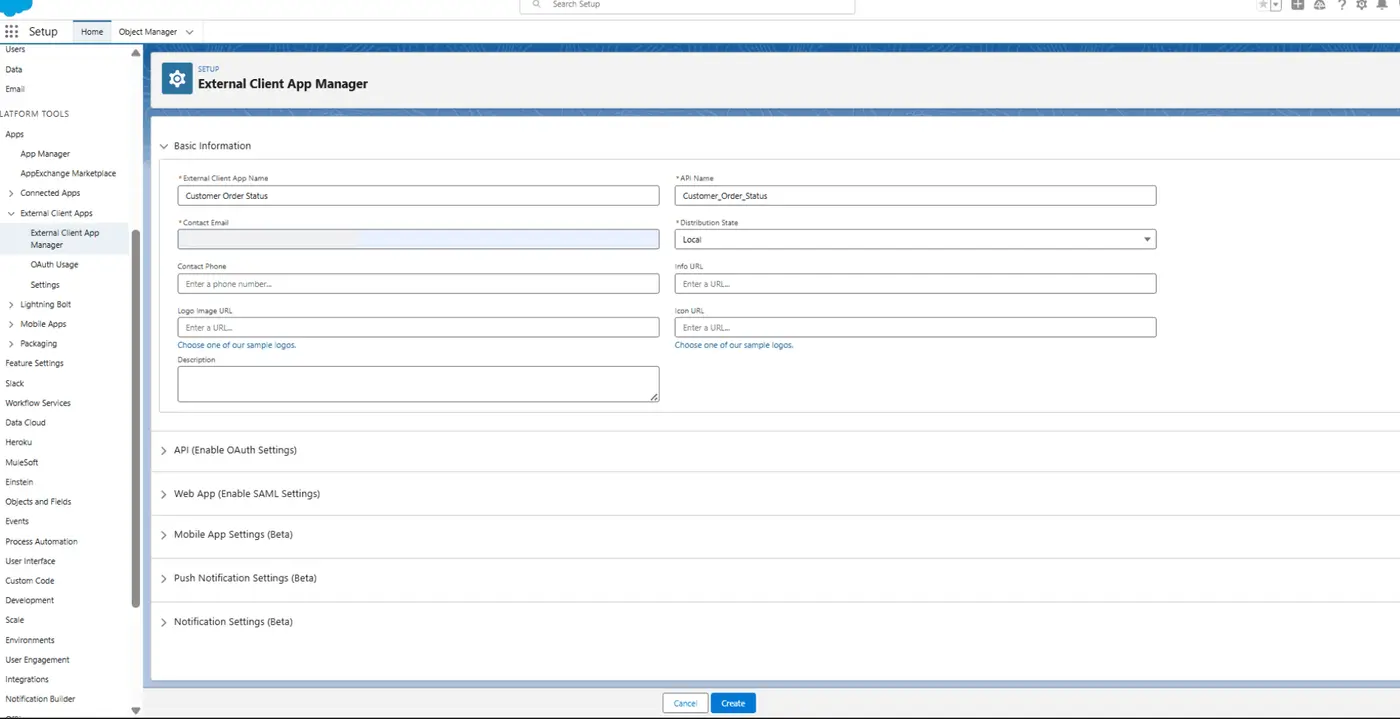
Click New External Client App. Enter an App Name (the API Name fills in), a Contact Email, and keep Distribution State as Local.
-
Expand OAuth Settings and check Enable OAuth.
-
Set Callback URL to
https://backend.composio.dev/api/v1/auth-apps/add. It must exactly match the auth config'soauth_redirect_urifield. -
Add OAuth scopes. The default auth config requests
full,refresh_token, andopenid, so select Full access (full), Perform requests at any time (refresh_token, offline_access), and Access unique user identifiers (openid). -
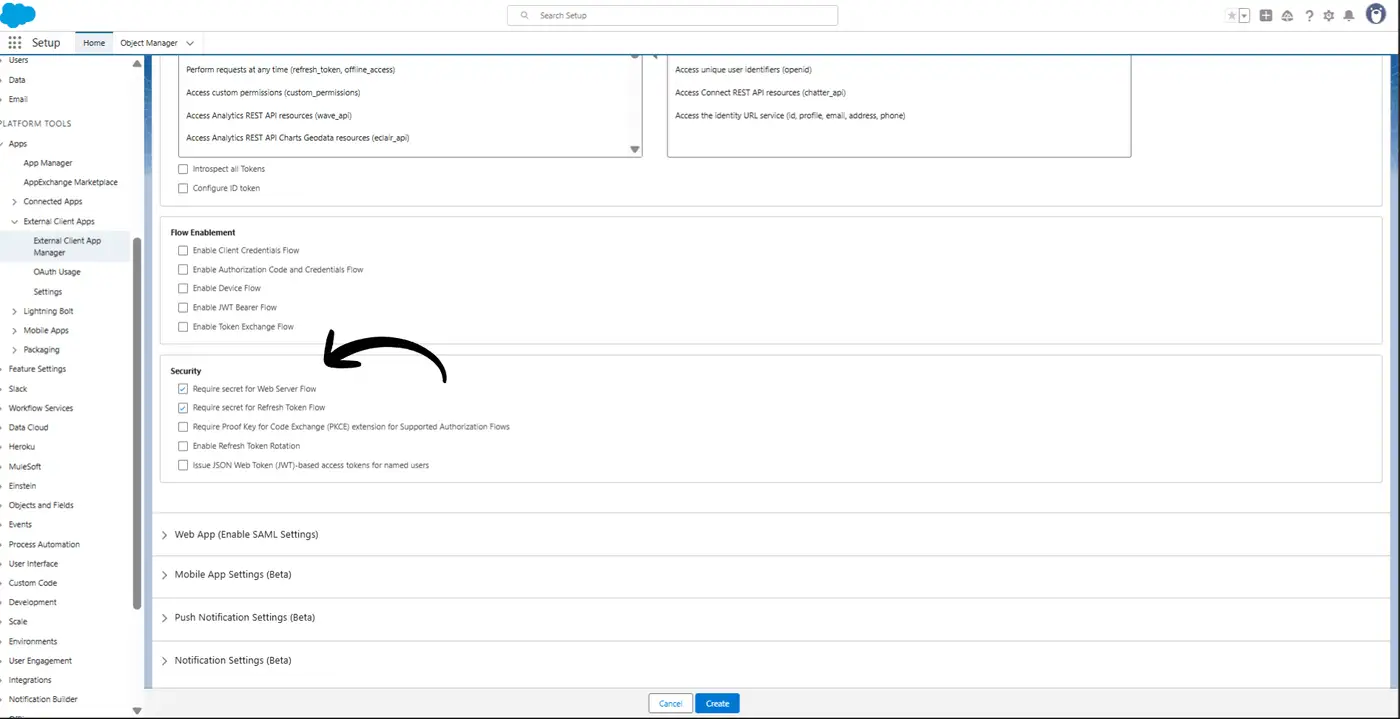
Under security, keep Require Secret for Web Server Flow and Require Secret for Refresh Token Flow checked. Uncheck Require PKCE unless you plan to use PKCE.
-
Save. Open the app's Settings tab → OAuth Settings → Consumer Key and Secret and copy the Consumer Key (client ID) and Consumer Secret.
Option B: Connected App
-
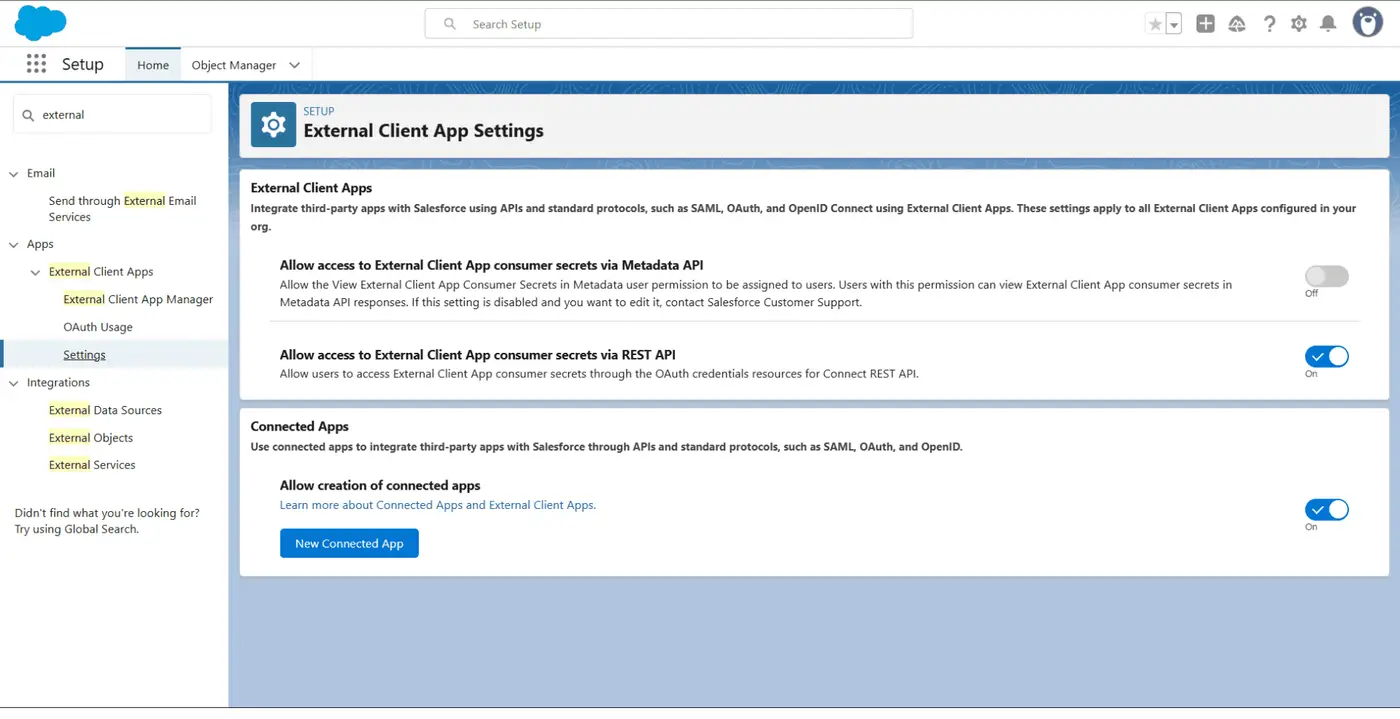
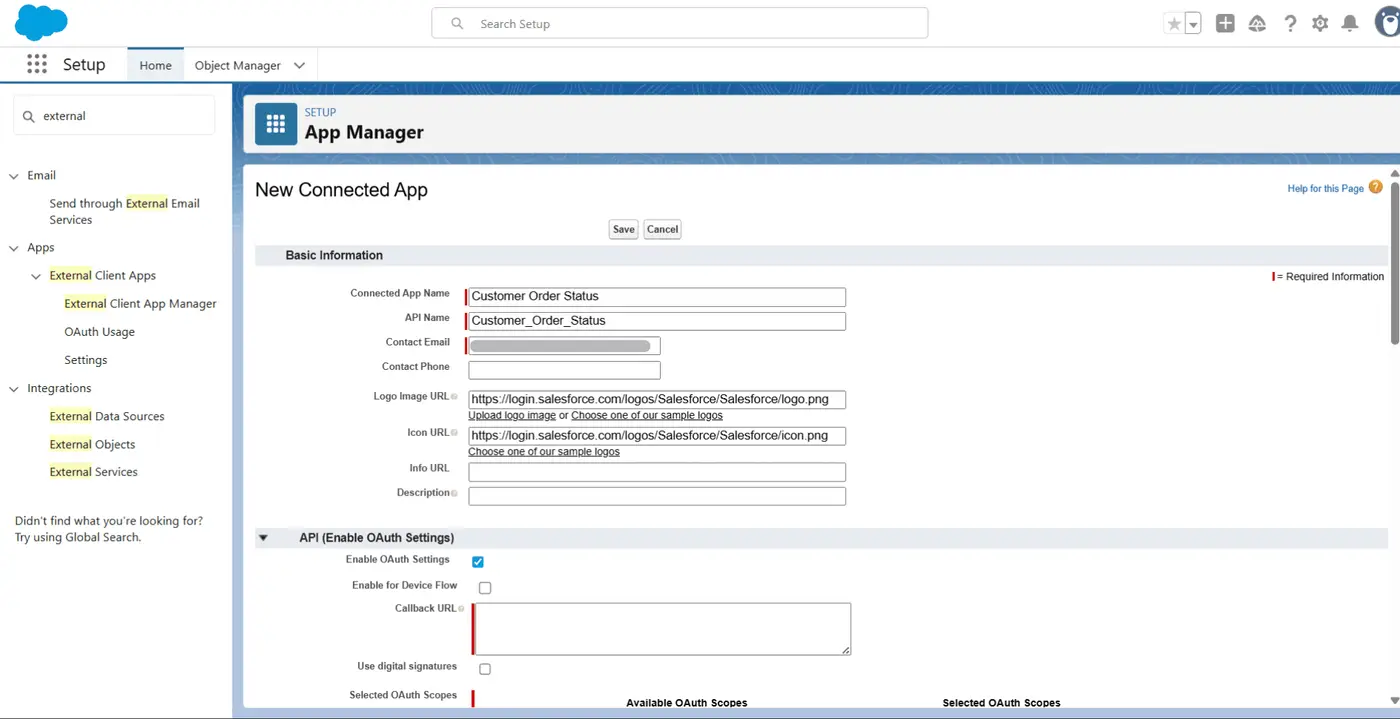
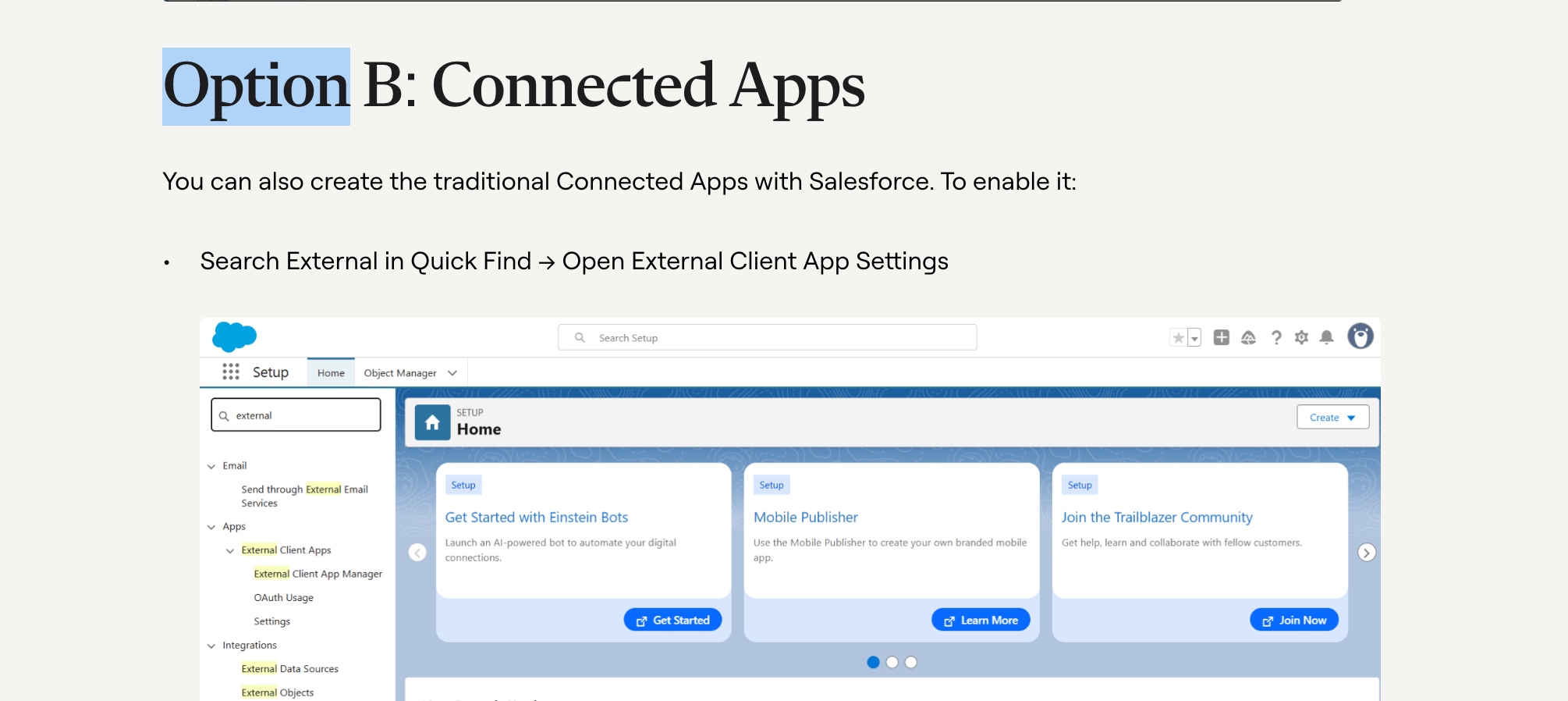
In Setup, search External Client App Settings in Quick Find and turn on Allow creation of Connected Apps. Then click New Connected App.
-
Enter a Connected App Name and Contact Email.
-
Under API (Enable OAuth Settings), check Enable OAuth Settings and set Callback URL to
https://backend.composio.dev/api/v1/auth-apps/add. -
Add the same scopes as in Option A:
full,refresh_token, offline_access, andopenid. Add others such asapiorid, profile, emailif your tools need them. -
Keep the web server flow and refresh token flow enabled with Require Secret for Web Server Flow checked, and save. Salesforce can take about 10 minutes to provision a new Connected App.
-
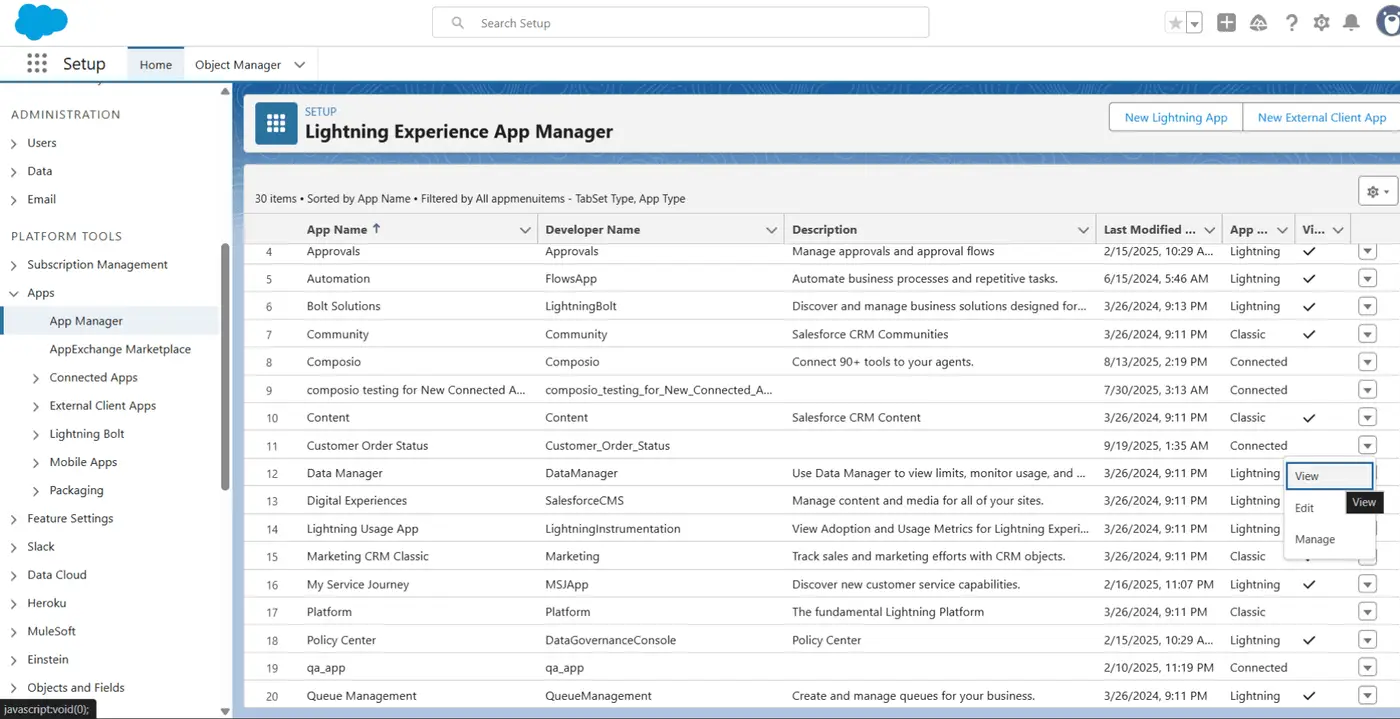
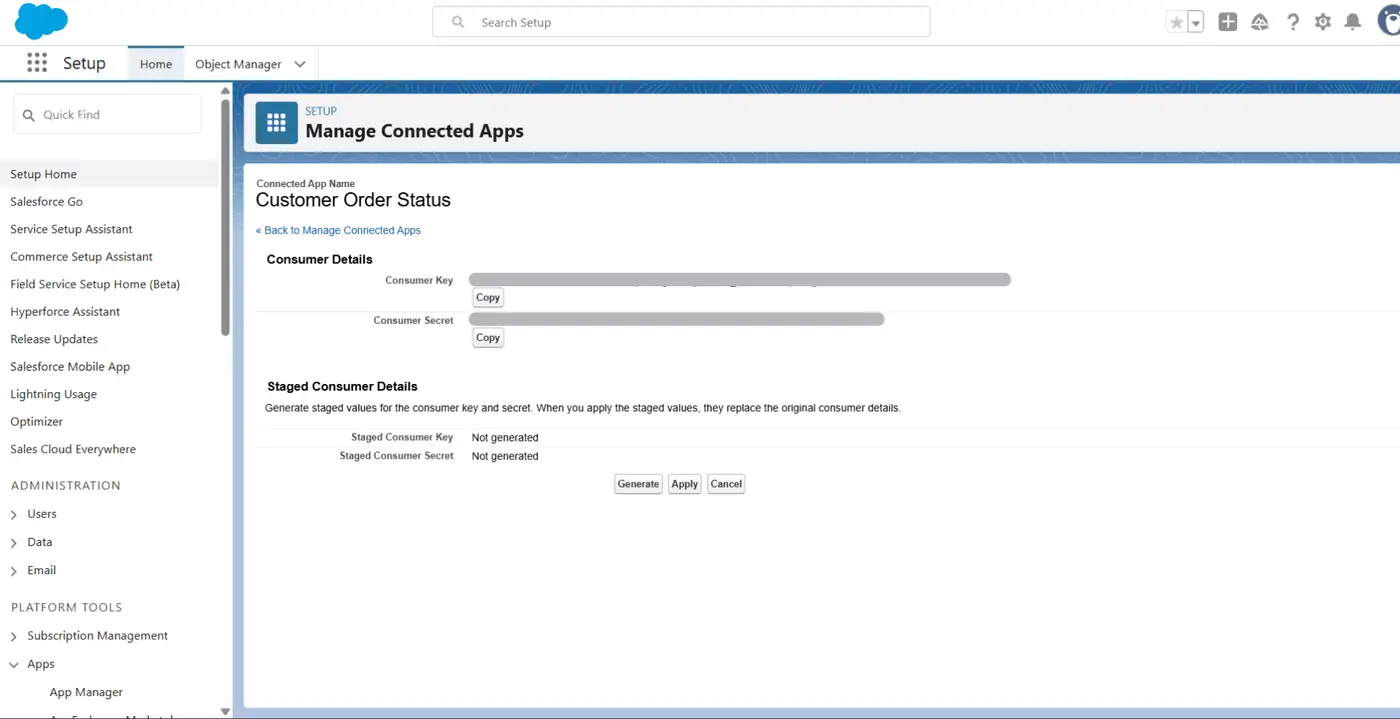
In App Manager, open the app's row menu → View → Manage Consumer Details, verify your identity if asked, and copy the Consumer Key and Consumer Secret.
Create the auth config in Composio
-
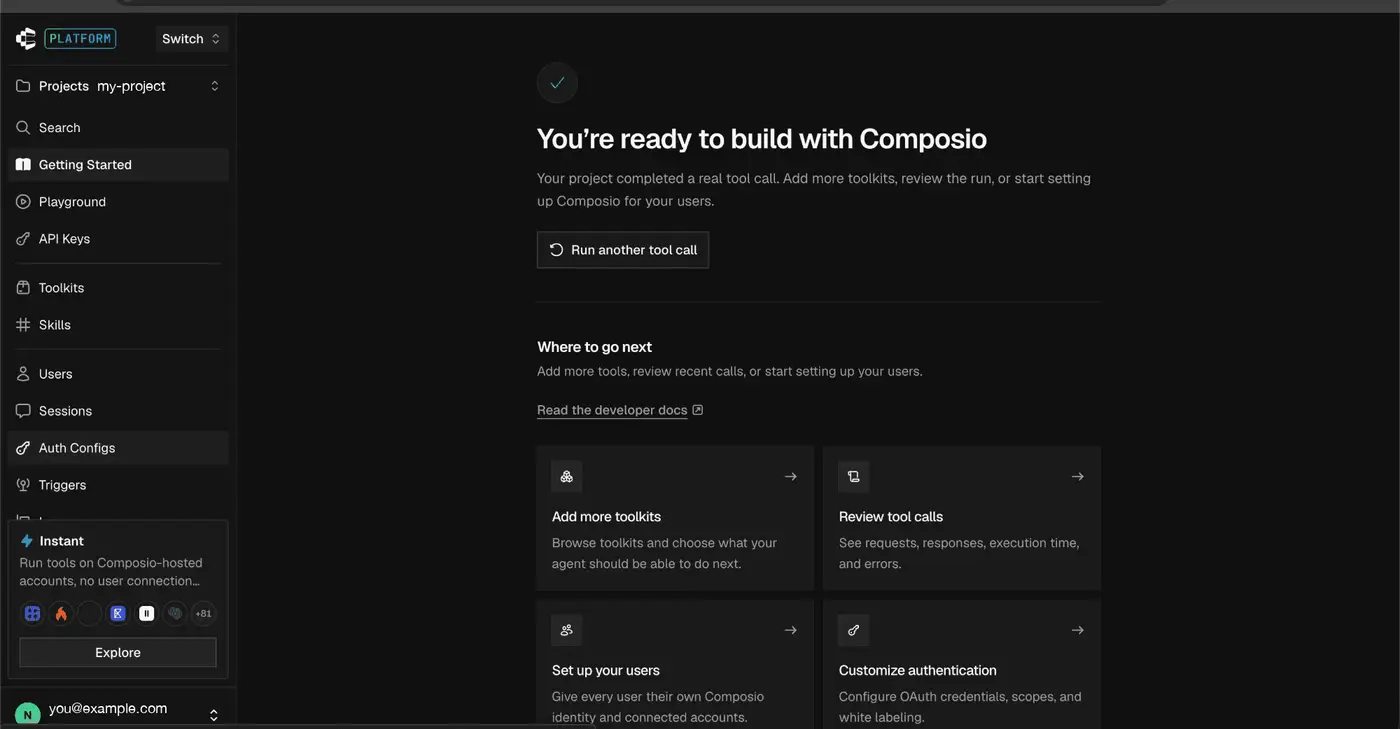
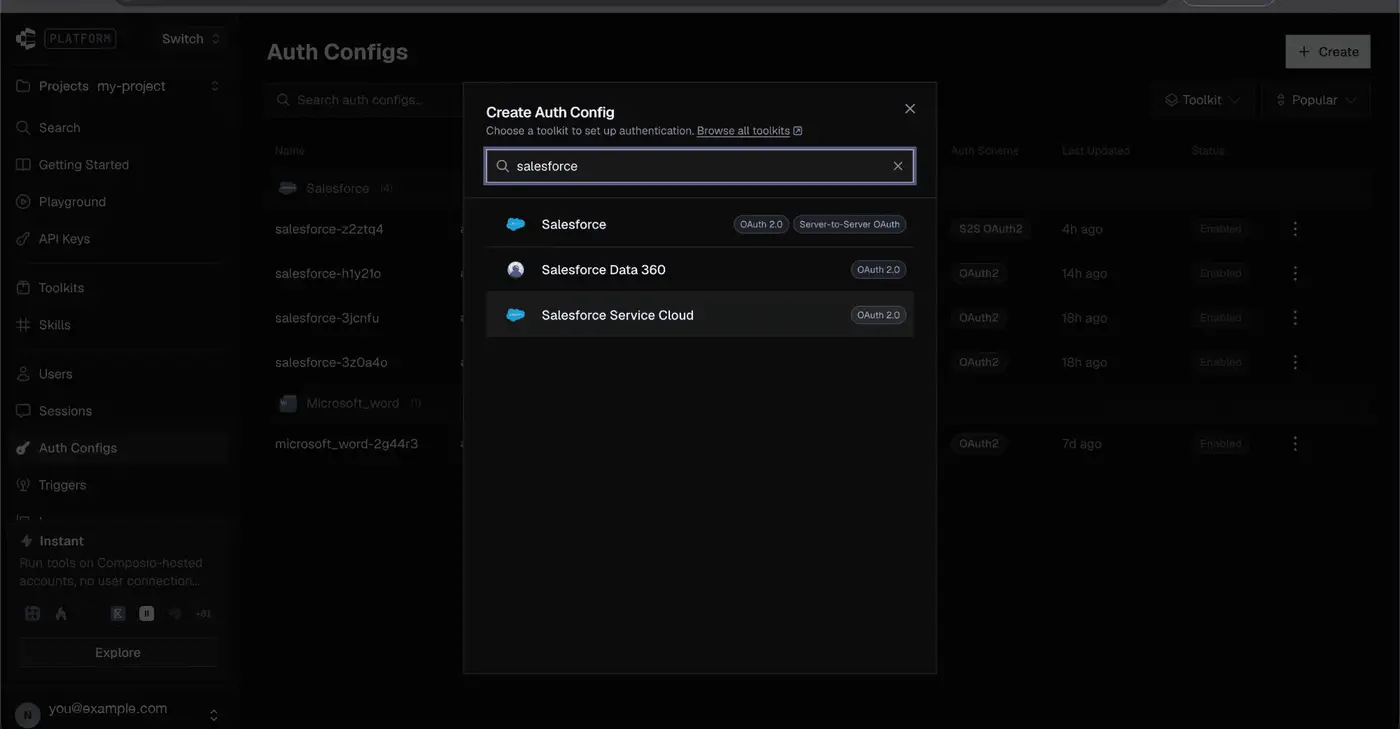
In the Composio dashboard, go to Auth Configs → Create and select Salesforce. Salesforce Data 360 and Salesforce Service Cloud are separate toolkits.
-
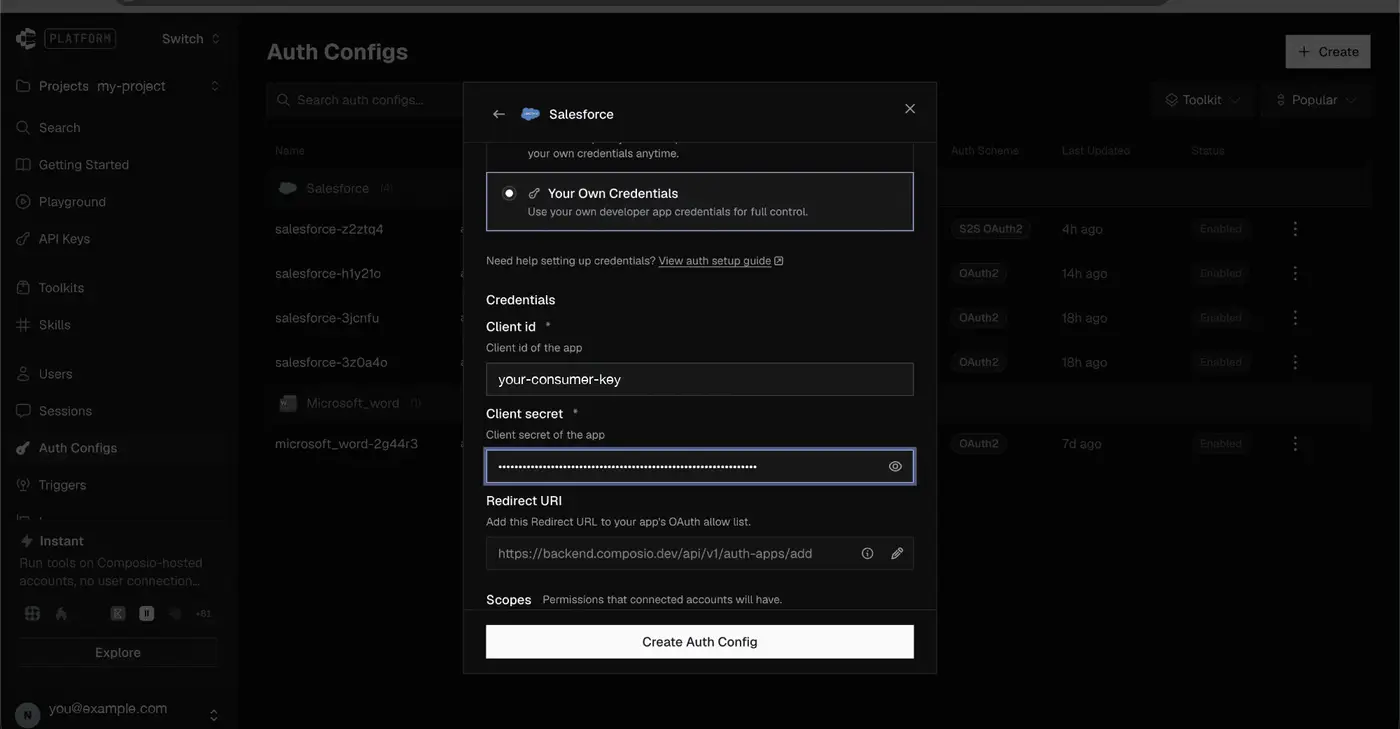
Choose OAuth 2.0 and Your Own Credentials. Paste the Consumer Key as the client ID and the Consumer Secret as the client secret. Keep the redirect URI as the value you registered in Salesforce. Click Create Auth Config.
-
Click Connect Account and fill in the connection fields:
- Subdomain: the part of your Salesforce URL before
.salesforce.com. Most orgs can keep the defaultlogin; Composio detects your instance after you sign in. If your org requires My Domain login, enter the My Domain part, such asacme.myforacme.my.salesforce.com(search My Domain in Setup). For a sandbox, entertest. - Instance endpoint: the API version path. Keep the default
/services/data/v67.0unless your org needs another version.
- Subdomain: the part of your Salesforce URL before
-
Sign in to Salesforce, review the permissions, and click Allow. Confirm the account shows Active on the auth config's Connected Accounts tab.
See custom auth configs for the general flow.
IP allowlists
If the app uses Enforce Refresh Token IP Allowlist, or your org restricts logins with Login IP Ranges or Network Access trusted IPs, add the four Composio outbound IP addresses. For an External Client App, open External Client App Manager, choose Edit Settings from the app's row menu, expand OAuth Settings, and under Refresh Token IP Allowlist click + for each address, with the same value as the start and end IP. Add the addresses and wait 30 to 45 minutes before you turn on enforcement. Otherwise token refreshes fail with IP restricted by the app developer (see below).

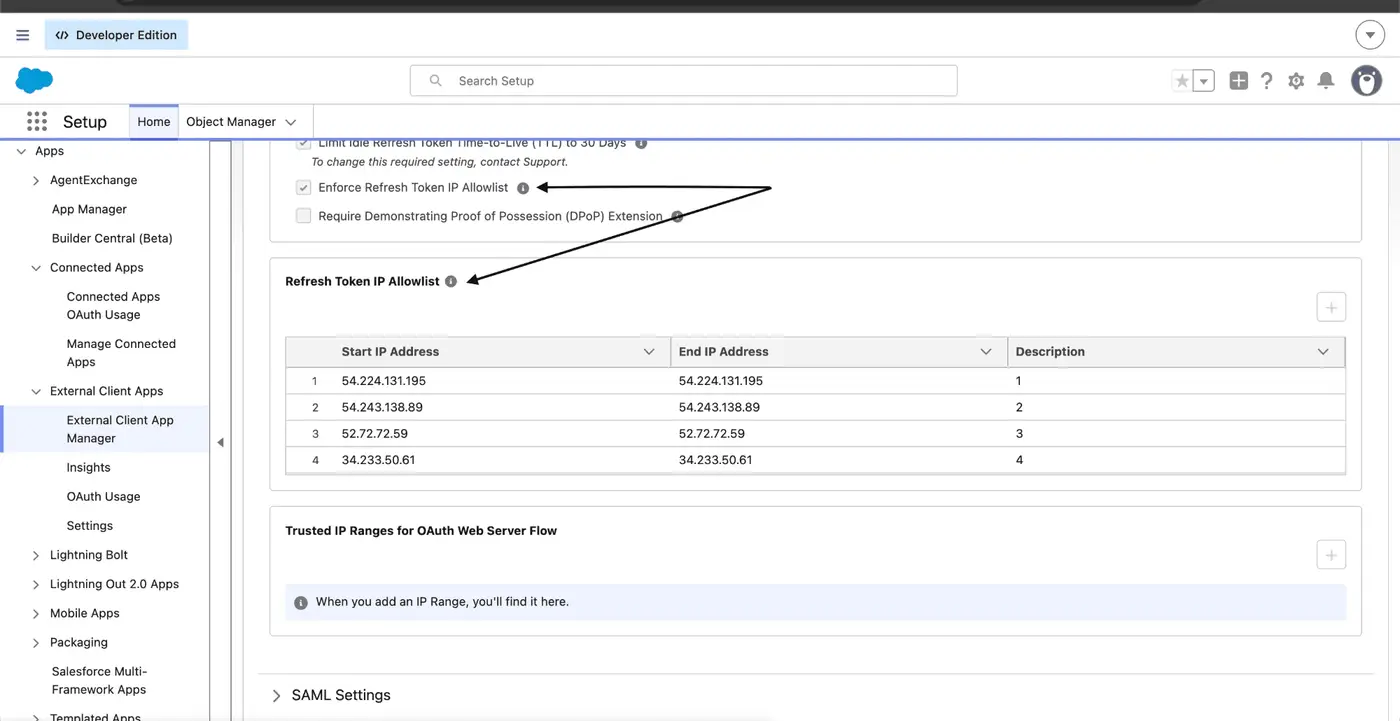
Some orgs also set Limit Idle Refresh Token Time-to-Live (TTL) to 30 days. In those orgs, a connection that isn't used for 30 days expires and has to be reconnected.
URL_NOT_RESET usually means Salesforce subdomain was not configured and defaulted to login
URL_NOT_RESET can happen when the Salesforce org requires a specific My Domain value but the connection is using the generic login default or an incomplete subdomain. The default login value is fine for most Salesforce flows, but for org-specific failures recheck the Salesforce domain/subdomain values on the connection, pass the correct My Domain subdomain, and retry on the latest toolkit version if the issue was seen on an older pinned version.
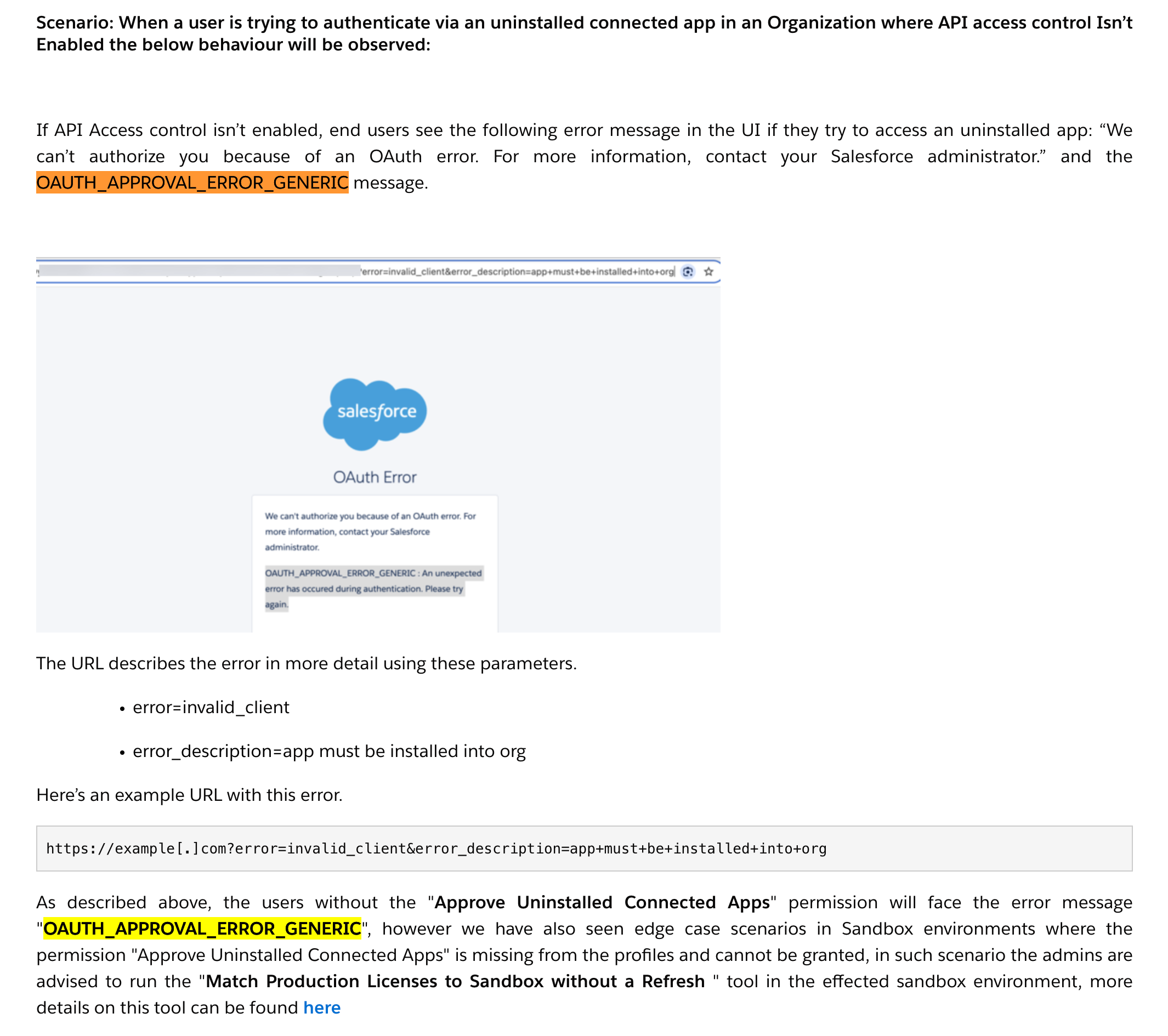
Why do I see OAUTH_APPROVAL_ERROR_GENERIC or app must be installed into org in Salesforce OAuth?
These errors usually mean Salesforce is blocking OAuth because the connected app has not been installed or approved for the org. The user may see OAUTH_APPROVAL_ERROR_GENERIC, or the callback URL may include error=invalid_client&error_description=app+must+be+installed+into+org.
Ask a Salesforce org admin to approve or install the connected app. In Salesforce Setup, search for External Client App Settings or OAuth Connected App Usage, find the app, and use the install/approval action shown by Salesforce. After the admin approves the app, the user should retry the OAuth connection.
Why do I see invalid_grant with ip restricted by app developer?
Your Salesforce connected app or external client app only accepts requests from trusted IP addresses, and Composio's request came from an address that isn't on the list. New connections fail during OAuth, and existing connections expire when their tokens refresh.
Add all four Composio outbound IP addresses to the app's IP allowlist, including its refresh token IP allowlist if it has one. Add each address as its own range, with the same start and end IP. Alternatively, set the app's IP relaxation policy to relax IP restrictions.
After you update the allowlist, ask affected users to reconnect. Connections that expired don't recover on their own.
Salesforce allows only five active refresh tokens per user per app
Salesforce allows only five active refresh tokens per user per connected app. When the same Salesforce user connects a sixth time, Salesforce can revoke the oldest refresh token, which makes older Composio connected accounts fail with token errors. If the consent screen says you've already granted access five times, clicking Allow revokes the oldest approval. To keep that connection, click Deny and revoke an approval you no longer need first. Also check whether the user changed their password, revoked the app, changed connected app refresh-token policy away from valid until revoked, or has org-level session policies that invalidate tokens.
How do I query relationships like Pricebooks and Opportunities?
Use SOQL subqueries to traverse relationships. For example, Products → Pricebooks → Opportunities:
SELECT Id, Name,
  (SELECT Id, Quantity, UnitPrice, TotalPrice, PricebookEntry.Product2.Name FROM OpportunityLineItems)
FROM Opportunity
What happens to deprecated Salesforce tools?
Deprecated tools continue to work until removed. Check tool descriptions for "DEPRECATED:" markers.
Why can't I find items I created in Salesforce?
Created records may not appear in a given Salesforce view. Use search to confirm they exist.