Before Execution Modifiers
If you're building an agent, we recommend using sessions instead. See Tools and toolkits for how sessions handle tool discovery and execution automatically.
Before execution modifiers are part of Composio SDK's powerful middleware capabilities that allow you to customize and extend the behavior of tools.
These modifiers are called before the tool is executed by the LLM. This allows you to modify the arguments called by the LLM before they are executed by Composio.
Useful for:
- Injecting an argument into the tool execution
- Overriding the arguments emitted by the LLM
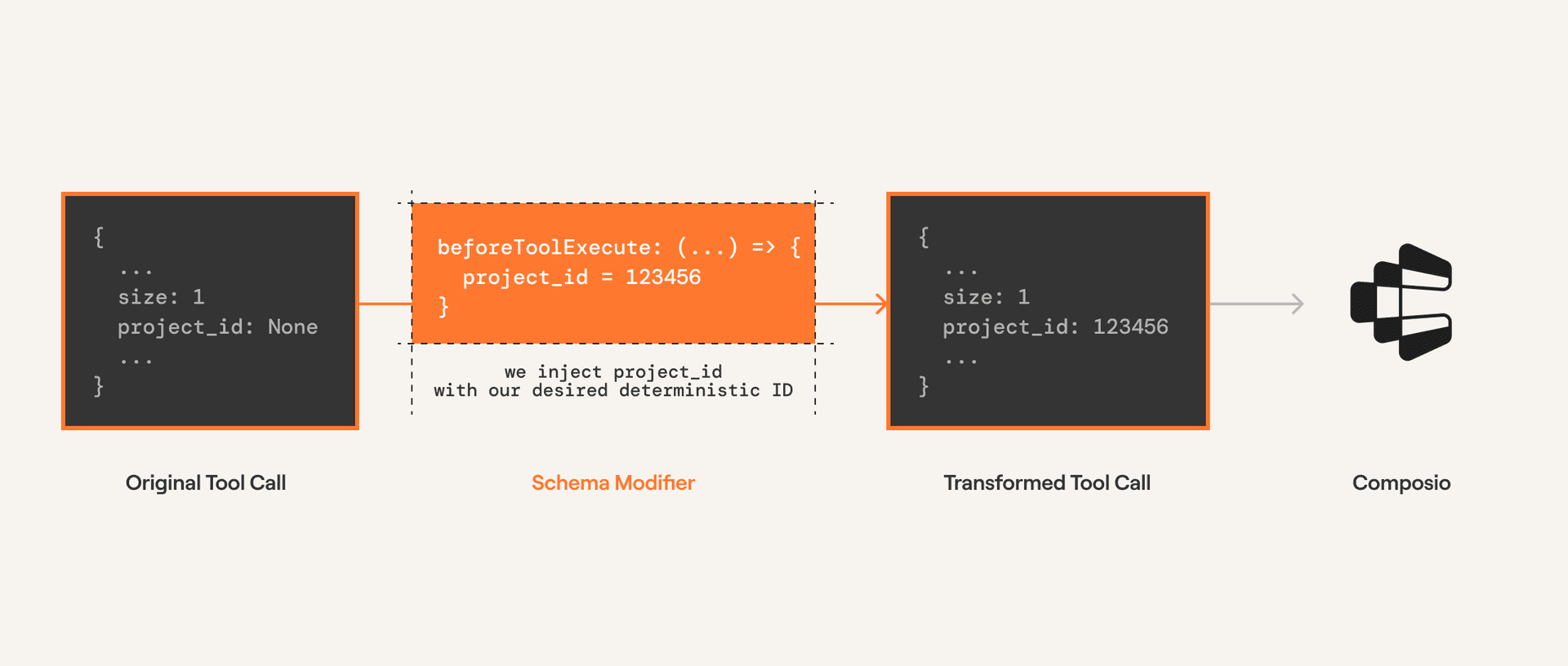
Below we use the beforeExecute modifier to modify the number of posts returned by HACKERNEWS_GET_LATEST_POSTS.
With Chat Completions
Since completion providers don't have a function execution step, Composio executes the tool call directly. The modifier is configured on the tools.execute method.
from openai import OpenAI
from composio import Composio, before_execute
from composio.types import ToolExecuteParams

composio = Composio(toolkit_versions={"hackernews": "latest"})
openai_client = OpenAI()
user_id = "user@email.com"

@before_execute(tools=["HACKERNEWS_GET_LATEST_POSTS"])
def before_execute_modifier(
    tool: str,
    toolkit: str,
    params: ToolExecuteParams,
) -> ToolExecuteParams:
    params["arguments"]["size"] = 1
    return params

# Get tools
tools = composio.tools.get(user_id=user_id, slug="HACKERNEWS_GET_LATEST_POSTS")

# Get response from the LLM
response = openai_client.chat.completions.create(
    model="gpt-5.4",
    tools=tools,
    messages=[{"role": "user", "content": "Fetch latest posts from hackernews"}],
)
print(response)

# Execute the function calls
result = composio.provider.handle_tool_calls(
    response=response,
    user_id="default",
    modifiers=[
        before_execute_modifier,
    ],
)
print(result)
With Agentic Frameworks
Agentic providers have a function execution step. The modifier is configured on the tools.get method which modifies the execution logic within the framework.
from composio import Composio, before_execute
from composio.types import ToolExecuteParams
from composio_crewai import CrewAIProvider

composio = Composio(provider=CrewAIProvider())

@before_execute(tools=["LINEAR_CREATE_LINEAR_ISSUE"])
def modify_linear_project_id(
    tool: str,
    toolkit: str,
    params: ToolExecuteParams,
) -> ToolExecuteParams:
    params["arguments"]["project_id"] = "1234567890"
    return params

tools = composio.tools.get(
    user_id="default",
    tools=[
        "HACKERNEWS_GET_LATEST_POSTS",
        "HACKERNEWS_GET_USER",
        "LINEAR_CREATE_LINEAR_ISSUE",
    ],
    modifiers=[
        modify_linear_project_id,
    ]
)
Before file upload (Python)
For tools with file_uploadable parameters, the SDK can read a local path and upload the file before calling the Composio API. To audit, rewrite, or block those paths, use the @before_file_upload decorator and pass the decorated callables in modifiers to tools.get, tools.execute, or a tool router session’s tools(modifiers=...).
See Executing tools: security for local file paths for constructor options, errors, and a full tabbed example.
The hook takes either a single context argument (preferred) or the legacy
3-arg (path, tool, toolkit) form. The context object exposes
context["source"] — "path" for local filesystem inputs and "url" for
http(s)://... inputs — so you can scope audits to just local paths:
from composio import Composio, before_file_upload

@before_file_upload(tools=["GOOGLEDRIVE_UPLOAD_FILE"])
def audit_path(ctx) -> str | bool:
    # ctx = {"path": ..., "source": "path" | "url", "tool": ..., "toolkit": ...}
    if ctx["source"] != "path":
        return ctx["path"]  # let URLs through untouched
    # return a new path string, or False to abort the upload
    return ctx["path"]

composio = Composio(toolkit_versions={"googledrive": "latest"})
composio.tools.execute(
    "GOOGLEDRIVE_UPLOAD_FILE",
    {"file_to_upload": "/path/to/document.pdf"},
    user_id="user_123",
    dangerously_skip_version_check=True,  # required when running "latest"
    modifiers=[audit_path],
)- Composition:
before_file_upload-type modifiers in themodifierslist are applied in list order (after filtering by each modifier’stools/toolkitsscope). Chaining works like a pipeline: each hook receives the path produced by the previous one. - Relative to
before_execute: automatic file substitution runs beforebefore_executemodifiers, matching TypeScript behavior (including tool routerexecute_meta).
Next
After execution modifiers
Transform tool results after execution